
Dulce de Carne Membrillo

Quince cheese

image

imageQuince is a member of the pear family and grows on trees of up to 8 metres high which fruit in the autumn. Their aroma is exquisite, however they are far too tart to eat raw and must be cooked.

In Spain dulce de carne membrillo (literally translated as sweet of quince meat) is typically eaten at Christmas with manchego, however it’s delicious with any full flavoured cheese. It’s a good idea to make it a couple of months prior to the festive season as this will allow the quince paste to harden into a cheese like consistency. We are lucky in the UK that quince trees are found in back gardens so if it’s a good year and there’s a bumper crop your neighbours will be more than willing to give you a few.

Makes about 500g

Ingredients
1 kg quince (5-6 quince)
500kg preserving sugar (depending on weight of quince pulp)
vegetable oil

Method

  1. Wash the quince and chop roughly (no need to peel or core).
  2. Place in a large pan with 0.75 litres of water. Bring to the boil and lower the heat to simmer until the quince have softened.
  3. Push the softened fruit and pan juice through a sieve to remove the skin and core.
  4. Now weigh the pulp and stir in the same weight of sugar into the fruit.
  5. Place the mixture back into the pan and gently bubble until the sugar has dissolved. The mixture should have thickened into a runny paste.
  6. Transfer the paste into a lightly greased baking dish/tray and cook over night (at least 10 hrs) or until the paste has started to solidify so that it can then be cut and handled.
  7. When cool cut into squares and wrap each one in greaseproof paper. Store in a cool dry place or in the fridge. It will become firmer with time so that it can be sliced when served.

Churros

image

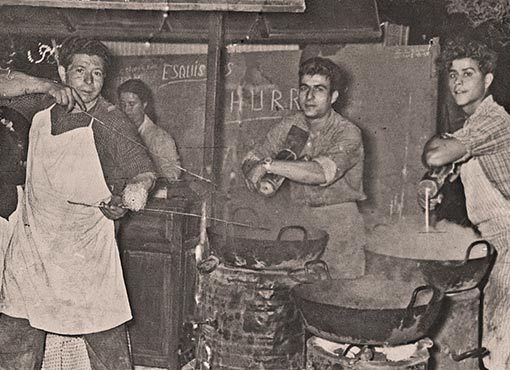
I love churros but not the sweet chocolate coated variety you find at fiestas. The churros I grew up with were savoury, home made and eaten as a Sunday breakfast treat. Mum would make spirals of churros in a frying pan and then stack them in the centre of the kitchen table for the family to gorge ourselves on. So if you fancy doing something different this weekend, aren’t calorie counting and are prepared to get messy – you have to try this. Your nearest and dearest will love you for it!

I recommend eating your churros with a good coffee, followed by a fresh fruit salad.

As a child in La Linéa, Juani and her family would visit their local imageChurrería in El Barrio on Sunday mornings. The churros were fried in huge deep pans and either made into large spiral wheels (for an entire family) or into fingers as individual portions. The churros were eaten for breakfast with a hot drink of coffee, hot chocolate (Cola Coa) or in my mum’s case a cup of tea!

Ingredients
175g self raising flour
pinch of salt
150ml tepid water
300ml vegetable oil

Equipment
Piping bag with a 10mm round nozzle  (or a churros pipe)

Method

  1. Sift the flour into a large bowl and mix in the salt.
  2. Create a well in the middle of the flour and gradually add the water.
  3. Using a fork gradually combine the water into the flour until you have a thick batter
  4. Heat up the vegetable oil in a large frying pan.
  5. Spoon the batter into a piping bag.
  6. Once the oil is up to temperature (you can drop some of the batter into the oil to test it – once the batter sizzles it’s ready).
  7. Pipe the batter starting from the centre of the pan working outwards in a circular motion.
  8. Allow to fry over a medium to hot pan for a few minutes and then turn over to cook the other side. Your churro should be a golden colour.
  9. Place the churro on a plate covered  in a kitchen towel and serve immediately.

Tip: Make sure the batter is thick enough so that it keeps its form as it is piped into the frying. Otherwise it’ll end up like a pancake! Add a little more flour if it gets too thin.

Gazpacho

image
Like our British summer, these gazpacho shots are short sharp bursts of sunshine. The intense colour and refreshing, zesty flavour is perfect for hot days and is ideal as a starter at a BBQ or picnic.

Gazpacho originates from Andalucía and is typically eaten during its intense hot summers as a cold soup. It is incredibly easy to make using raw ingredients and if you are lucky enough to grow your own tomatoes and cucumbers then this is a great way to capture their full flavour.

Makes 1 litre

1 kg ripe tomatoes
1 long green pepper (or half a green bell pepper)
½ cucumber
1 clove garlic (skin removed)
1 slice of white bread /or 2” length of baguette
2tbs white wine vinegar
4 tbs of extra virgin olive oil
Pinch of salt

Method

  1. Roughly chop all the vegetables and ripped up the bread
  2. Add all the ingredients in a blender or large bowl/ saucepan (if using a hand held liquidiser) and blend until smooth. (Tip: If after blending the gazpacho is very thick and difficult to pour, try adding more cucumber to thin it, then whizz it up again).
  3. Enjoy immediately or chill for three hours before serving.